
Most shops already know where time disappears — it’s not always in the primary cut.
It’s in the small, repeat operations around it.
Spotting.
Chamfering.
Engraving.
Grooving.
Corner rounding.
Individually, none of these justify much attention. Collectively, they introduce unnecessary tool changes, additional offsets and more variation into the process than they should.
The Real Issue Isn’t the Operation — It’s the Tooling Approach
Running separate tools for each secondary operation is standard practice, but it comes at a cost:
- More tool positions occupied
- More offsets to manage
- More changeover during setup and adjustment
- More opportunity for inconsistency between runs
In high-mix or production environments, this becomes a constant background inefficiency.
Consolidating Secondary Operations
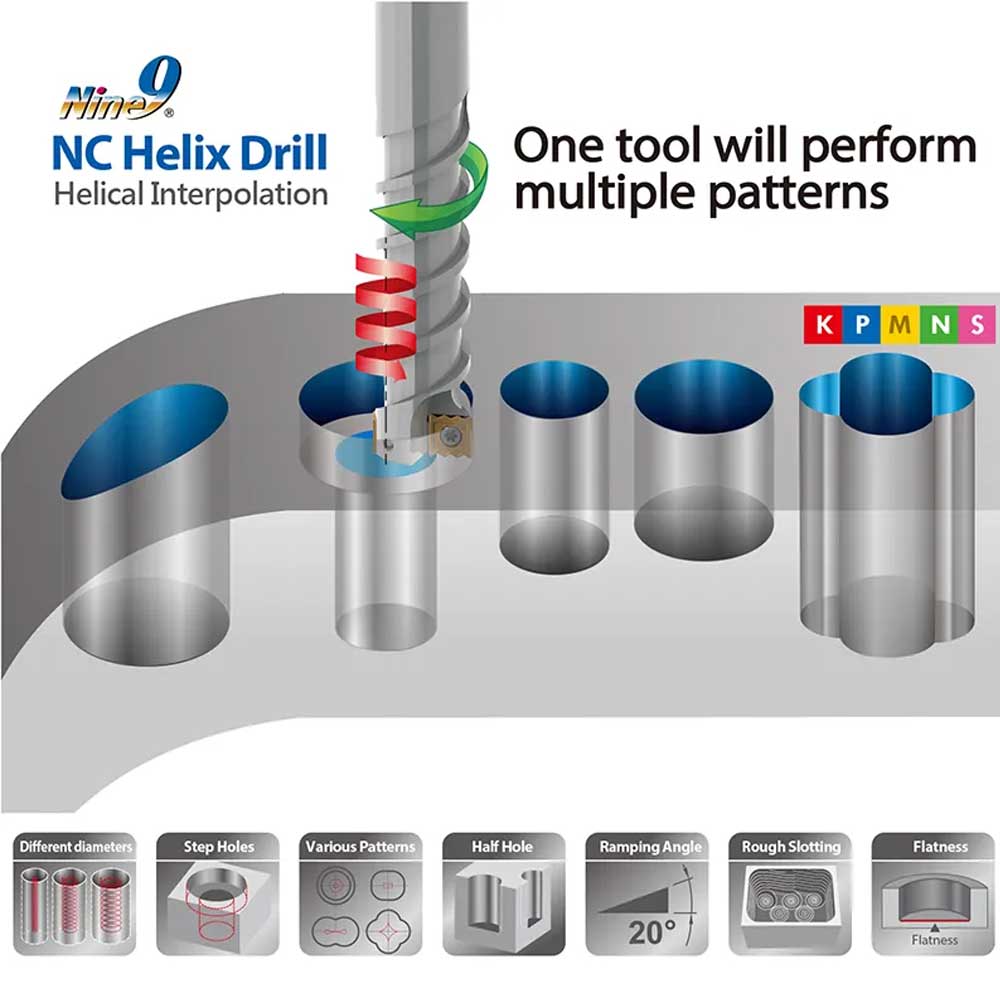
The Nine9 NC Spot Drill takes a different approach — not by improving a single operation, but by reducing how many tools are needed to complete them.
Using a single holder with interchangeable inserts, the same tool can cover:
- Spot drilling
- Chamfering
- Engraving
- Grooving
- Corner rounding
Insert angle options from 60° to 145° allow the geometry to be adapted without removing the holder from the machine.
Fewer Tool Changes, Less Variation
Reducing tool changes isn’t just about saving time — it’s about control.
Every additional tool introduced into the process brings:
- Another offset
- Another potential deviation
- Another point of inconsistency
Consolidating operations into a single tool system reduces that stack.
For many setups, this leads to:
- Cleaner tool libraries
- Faster changeovers
- More consistent results between batches
Practical Impact on Setup
The benefit shows up most clearly during setup and adjustment.
Instead of managing multiple tools for secondary features:
- One holder remains in position
- Insert changes are quick and predictable
- Fewer offsets need to be touched
It’s a small shift, but across multiple jobs and setups, the time saving compounds quickly.
Material and Application Range
With the appropriate insert grades, the system covers typical workshop requirements without changing tooling strategy:
- Carbon and alloy steels
- Stainless
- Cast iron
- Non-ferrous materials
- Titanium and heat-resistant alloys
- Hardened materials up to HRC 56
This makes it viable across mixed workloads without adding complexity.
Where It Makes the Most Difference
This type of tooling isn’t about replacing core machining operations — it’s about tightening up everything around them.
It tends to have the most impact where:
- Multiple secondary features are required
- Tool positions are limited
- Setup time is under pressure
- Repeatability between runs matters
A More Efficient Way to Handle Secondary Work
Most of the time, the inefficiencies in a machining process aren’t dramatic — they’re incremental.
A few seconds here. A small adjustment there. Another tool loaded “just in case.”
Multi-function tooling reduces that accumulation.
Not by changing how the part is machined, but by simplifying how the work is approached.
Explore the Nine9 NC Spot Drill Range
If your current setup relies on multiple tools for secondary operations, it’s worth reviewing whether those steps can be consolidated.
https://advancedcarbidetooling.com/collections/nc-spot-drill